PHNOM PENH, Sept. 29 (Xinhua) -- Cambodia's Ministry of Commerce and the Food and Agriculture Organization of the United Nations (FAO) held one-day meeting Tuesday to discuss on how to strengthen Cambodia's food safety control systems and reduce the negative impact of food-borne diseases to consumers, producers, vendors and government authorities.

The meeting is aimed at improving the capacity of concerned national agencies to develop, implement and monitor national food control strategies that reflect the multi-disciplinary nature of food control, according to FAO.

At the opening of the forum, Chan Nora, secretary of state of Ministry of Commerce said improving food safety and its management is among the strategies adopted by the Royal Government of Cambodia to diversify its products and promote long term economic sustainability.

He said reducing the prevalence of food-borne diseases will improve consumer health and increase trade in food and agricultural products, and adding that adopting a policy of facilitating trade through risk management will allow the integration of Cambodia's economy into the region and the world.

The meeting participated by several dozens of officials and representatives from the Ministry of Commerce, Ministry of Industry, Mines and Energy, Ministry of Agriculture, Forestry and Fisheries, Ministry of Health and Institute Pasteur du Cambodge who are involved in food safety participated.

"Food-borne diseases remain a leading cause of illness. Food safety problems such as intentional chemical adulteration, excessive and inappropriate use of pesticide in farming have a negative impact on public health, and subsequently on economic development," said Chan Nora.

FAO has been assisting the government in identifying how concerned agencies, scientists and staff can work together to analyze the problems and evaluate options for addressing them.

Dr. Lotfi Allal, acting FAO Representative, said FAO gives high priority to food safety and recommends the use of the risk analysis system.

Thai-ASEAN News Network

The situation along the Thai-Cambodian border is still calm without fresh military movements after the Cambodian leader's aggressive remark against Thailand on the border dispute issue.

Thailand and Cambodia have not deployed more troops around the Preah Vihear Temple yet despite the reported aggressive statement made by Cambodian PM Hun Sen that he will order his troops to shoot whoever trespasses on Cambodian land. The atmosphere at the border area in Si Sa Ket's Kantharalak district is still quiet with Thai troops keeping security there.

Meanwhile, residents of Kantharalak's Phumisarol village close to the Thai-Camobdian carry on with their daily activities as usual without concern over a possible clash between Thai and Cambodian troops.

At the border area of Tamuen Thom and Tamuen Kwai temples in Surin province, Thai and Cambodian security forces still carry out their regular patrols along the border. No sign of tension has been seen so far.
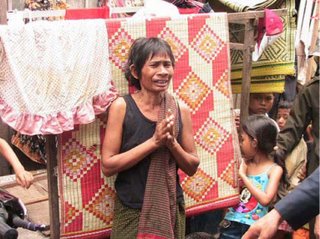
The miserable situation of neglected renters in Dey Kraham area

Phnom Penh (KI-Media) - Recently, the Phnom Penh municipality has decided to sell to the private company 7NG about 4.7 hectares of land in Phnom Penh, in an area know as Dey Kraham (Red Earth), located near the newly built National Assembly buildings. Almost 1,500 families are calling this area their homes. Most of them have been living here for ten years or more. Almost 1,200 houses have already been demolished. The owners of the demolished houses are usually well off and do not even live there, these houses were in fact mainly rented out to poor urban working class of Phnom Penh.

While the homeowners are compensated by the private company which bought the land, the renters are faced with serious hardship. As can be seen in the photos below, these renters who already faced miserable living conditions under the opulence of the “rich” and “super-rich” society of Phnom Penh, saw themselves thrown out, quite literally, on the street following the demolition of the houses they rented a few days earlier. Having nowhere to go, they live on the streets, or any unoccupied spots they can get a hold of. Some more fortunate ones still have a bed made out of scrap wood and some plastic tarps to cover what they call their new homes. Others, less fortunate, are lucky enough to have a scrap of wood to cover the dirt they sleep on. If the living condition was miserable before, their current condition is plainly unhealthy: they are forced to live outdoor under the rain, the wind, and the scorching sun. As can be seen on these photos, several of them are old and sick, a majority of them are women and young children, some of whom are already lacking food.

Unlike the renters of the Sambok Chap area who were offered a small plot of land outside of the city, renters in the Dey Kraham area were simply told by the authority to vacate the area. No alternative options have been offered by the municipality of Phnom Penh to these people thrown out in the street. In the name of development, a large number of poor people are forced to face very serious hardship while the authorities are turning a neglectful blind eye to their misery.

The following photos speak for themselves.


AddThis
"Cambodia, as a democracy, is a teenager in terms of years, and an infant in terms of maturity. Democracy in Cambodia is so fragile and now this attack on democracy poses serious concerns on the health and existence of democracy."
In a democracy, you need democrats. Cambodia purports to be a democracy. However, within recent months, the government has been going after democrats and human rights defenders in a more concentrated manner in the crackdown on political opposition, civil society and media which greatly undermines democracy.

Theary Seng with Mr. Phin Malay (center) in Toulouse, prior to a 2-hour call-in radio program on Canal Sud 92.5 FM (in Khmer and English) on democracy and human rights in Cambodia, 7 July 2009.

Cambodia, as a democracy, is a teenager in terms of years, and an infant in terms of maturity. Democracy in Cambodia is so fragile and now this attack on democracy poses serious concerns on the health and existence of democracy. Since 1993, Cambodia has made important strides in democratic development, but now all of that is at risk in light of the concentrated crackdown on expression, opinions and assembly.

How then does the Cambodian government expect Cambodia to have a democracy?

Theary Seng, relaxing at dinner, after 2nd day of Fifth Ministerial Community of Democracies in Lisbon, 10 July 2009.

Lisbon 5th Ministerial of Community of Democracies, Portugal Foreign Minister getting up to give welcoming remarks, 10 July 2009. During this session, Theary Seng informed the participants of the crackdown in Cambodia and her removal from the Center for Social Development via a politically-motivated court injunction.

Fmr. U.S. Secretary of State Madeleine Albright who initiated the Community of Democracies ten years ago, attending the Lisbon Fifth Ministerial, 9 July 2009.

Theary Seng with democrats from Bangladesh, Afghanistan and Peru at the Lisbon Ministerial of Community of Democracies, 9 July 2009.

The situation is insidious in that the ruling party uses the semblance of democracy to combat democracy; that is to say, it uses "mock legality" of the court carry out its fiat. It criminalizes democracy and human rights activism; it weaponizes the law. A genuine democracy is rooted in the “rule of law”. An authoritarian regime bases its authority in the "rule by law" that it alone legislates, interprets and executes. Cambodia now follows the adage of other dictators: For my friends, whatever they want; for my enemies, the law.

AlJazeera TV interview with Theary Seng (reading Undermining Democracy) in Phnom Penh re her removal from the Center for Social Development via a politically-motivated court injunction, before her departure for meetings/conferences in Portland and Berlin, Aug. 2009.

Theary Seng as keynote speaker and panelist with Fmr. US Ambassador Sichan Siv at the KRT international conference in Portland, OR, requesting for action by Cambodian-American against authoritarian backlash against democrats and human rights defenders in Cambodia. 16 Aug. 2009.

Theary Seng speaking with German Federal Minister of Economic Development Mrs. Heidemarie Wieczorek-Zeul after Press Conference to celebrate 10th Anniversary of Civil Peace Service, Berlin, 19 Aug. 2009.

Another invidious trend which is undermining democracy in Cambodia and elsewhere is the use of legislation to curtail the work of civil society, ie, in the form of an NGO Law. Two recently, highly recommended publications address the authoritarian backlash against democrats worldwide, both specifically mentioned Cambodia: Defending Civil Society and Undermining Democracy.

Theary Seng meeting with Vice-President of German Parliament (Bundestag) to discuss culture of memorial and crackdown on democracy and human rights in Cambodia. Berlin, 28 Aug. 2009.

The Center for Social Development (CSD) case is really a simple case of simple people bent on destruction by taking their private grievances to the court, exploiting the political context of repression and crackdown on civil society, media and political opposition. Politics, in turn, took advantage of this opening to silence an outspoken civil society voice (mine) by giving the green light to the court to enforce this baseless injunctive order. In sum, the CSD issue started out as a private dispute which turned political.

I am no longer at the CSD as of August 27, the Municipal Court ruled on the substantive case striking down the recognition of me and the 11-member Board of Directors as accepted by the Ministry of Interior. To continue the work of CSD, we have established The Center for Justice & Reconciliation and The Parliamentary Center of Cambodia.

Theary Seng with German parliamentarian Hellmut Konigshaus after one-hour meeting with him to inform of the crackdown on democracy and human rights in Cambodia (very generous of his time in light of election campaign season!) and Friedrich Naumann Stiftung’s Asia director Christian and SEA program manager Moritz. German Bundestag Office, Berlin, 2 Sept. 2009.

Information communication technology (ICT) is without a doubt a powerful, fearful weapon against authoritarianism and the best friend of democracy and democrats. Movements and campaigns require the effective dissemination of information to rally up the support and ICT proves an effective tool in getting the message out to the larger audience which knows no boundary. During my 3 1/2 years at CSD, we emphasized the use of ICT in our work, particularly we did research through the iREACH pilot project in Kep on the use of ICT in empowering rural communities.


Khmer Rouge Tribunal: Success or Scandal. International conference for invited heads of institutions, parliamentarians and policy-makers, Berlin. Theary Seng with panelists Hon. Jurgen Koppelin (German parliamentarian who opposed the KRT) and German prosecutor Jurgen Assmann, organized by and moderated by Friedrich Naumann Stiftung’s Moritz Kleine-Brockoff, Berlin, 3 Sept. 2009.

Authoritarian regimes, which characterizes the Cambodian People’s Party, are afraid of truth and ideas; they function on fear, control and paranoia, in keeping the population ignorant to better manipulate them. They function best in secrecy and in the dark. Information and knowledge is light, it is power, hence a challenge to the authority and power of the CPP.

Hon. Tioulong Saumura (MP, SRP), second from left, on a special panel of Women in Political Leadership.

Theary Seng with democrats from India and Mongolia at WFDA Biennial Conference (Seoul, 16-18 Sept. 2009) where she addressed Democracy in Cambodia on a panel of Asian democrats from transitional countries.

For me, I have found that as a public figure, visibility is one layer of protection. We cannot vacillate back and forth and mourn the loss of privacy. I believe this awareness is important for human rights activists for visibility is a protective tool. With regards to CSD, I have been speaking out at the various conferences (ie, Community of Democracies, World Forum for Democratization in Asia, my meetings with the Vice President of the German Bundestag etc.) and in interviews for radio and TV, including an AlJazeera half-hour program on this crackdown... and will continue to speak out very strongly against any and all forms of authoritarianism, despots, for human lives and well-being are at stake here when democracy is under attack.


Cheam Adam outpointed Phan Sothy and Sok Ratha won by second-round disqualification Saturday to advance into the semifinals of CTN’s Kun Khmer Tournament of Champions. Phan Sothy (8-3-0) cut Cheam Adam (29-7-2) early with elbows, on the left temple in the first round and across the nose in the second, but a bloody Cheam Adam battled back, hurting Phan Sothy in the later rounds with kicks to the body and nearly putting him down in the fourth round. In the co-feature, Sok Ratha (6-3) could not recover from a low blow, prompting referee The Sarin to disqualify Seung Kangsan (24-3-9). Semifinals are scheduled for October 10 at the CTN boxing arena. Khun Makara will face Cheam Adam, and Sok Ratha will go against Poy Neurn.

In Brief: New ADB country head


THE Asian Development Bank (ADB) has announced a new Cambodia country head following the appointment of the previous director, Arjun Goswami, to Manila in the role of head of regional integration for Southeast Asia. Putu M Kamayana has already started as the replacement for Goswami in Phnom Penh, an ADB statement said Friday. Kamayana, an Indonesian, has worked for the bank since 1995 in the Philippines, Kazakhstan, Turkmenistan, Bangladesh and Vietnam, the announcement added.

In Brief: Rattan firms to unite


RATTAN suppliers and processors are due to meet today in Phnom Penh to form the country’s first rattan association with support from the global conservation group WWF and the European Union. It would aim to provide Cambodian producers with new knowledge and experience related to rattan, processing techniques, trade and markets, according to a joint press release. “The project identified that processors and exporters are not familiar with using the environmentally friendly production techniques and that there is lack of understanding about international market requirements,” WWF Rattan Project Manager Ou Ratanak said in the statement.

CAAI News Media; South Thailand


Police officers survey the site of a bomb attack by suspected Muslim militants at a Muslim cemetery in southern Thailand's Yala province, about 1,084 km (674 miles) south of Bangkok, September 27, 2009. The bomb attack killed one civil defence volunteer as he was cleaning the grave of his elder brother, police said. REUTERS/Surapan Boonthanom


Police officers survey the site of a bomb attack by suspected Muslim militants at a Muslim cemetery in southern Thailand's Yala province, about 1,084 km (674 miles) south of Bangkok, September 27, 2009. The bomb attack killed one civil defence volunteer as he was cleaning the grave of his elder brother, police said. REUTERS/Surapan Boonthanom


Police officers survey the site of a bomb attack by suspected Muslim militants at a Muslim cemetery in southern Thailand's Yala province, about 1,084 km (674 miles) south of Bangkok, September 27, 2009. The bomb attack killed one civil defence volunteer as he was cleaning the grave of his elder brother, police said. REUTERS/Surapan Boonthanom


A Thai soldier stands guard in Thailand's restive southern province of Yala. Suspected Islamic militants have shot dead three Muslims in separate attacks in Thailand's troubled south this weekend


News in Picture by CAAI News Media


In this photo taken Saturday, Sept. 26, 2009, AIDS volunteers Kajit Klinkachorn, 33, left, Saichon Booncharoen, 3rd left, Aree Gumpolrat, 32, right, and together with an NGO co-ordinator Pitchayapan Sripa, 33, 2nd left, share experience about being AIDS volunteers at Nong Tapan village in Rayong province southeastern Thailand. For the first time, an experimental vaccine has prevented infection with the AIDS virus, a watershed event in the deadly epidemic and a surprising result. Recent failures led many scientists to think such a vaccine might never be possible. The vaccine cut the risk of becoming infected with HIV by more than 31 percent in the world's largest AIDS vaccine trial of more than 16,000 volunteers in Thailand, researchers announced Thursday, Sept. 22, 2009. (AP Photo/Apichart Weerawong) (Post in khmernz.blogspot.com)

My Blog List

Followers

Blog Archive